
Tel: 01952 262 529
Fire safety

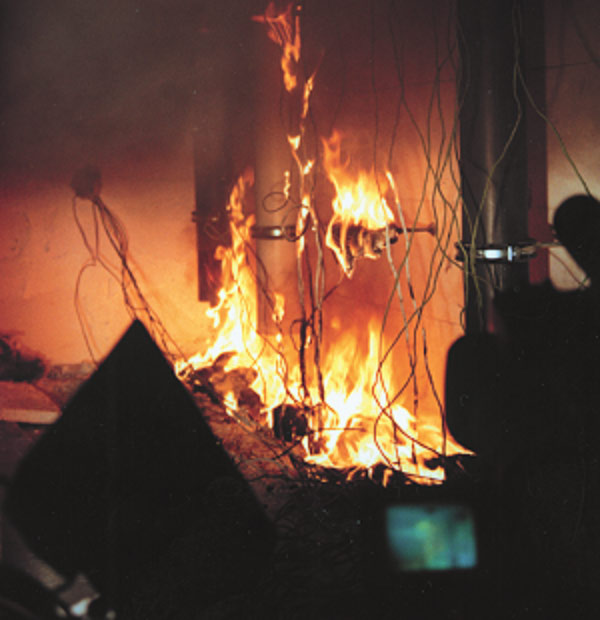
Drainage systems are the arteries of a building
Ensign Cast iron Drainage system has A1 fire rating
Our product range offers you the highest level of fire protection and product integrity to minimise any risks which could come from a fire. As a drainage system passes through the floors and walls of a building, this mustn't give any opportunities for the fire to spread along these arteries or add to fueling the fire. Therefore specifying a material that has an A1 fire rating will minimise risks and our Ensign Cast Iron Drainage system has this A1 fire rating. Cast Iron strength and stability means that there is virtually no movement in its life or in the event of a fire. This then leads to another key point, which is this stability means the method of backfilling the hole through a floor or a wall can be done with mortar, which again is a stable and minimal risk solution.
The drawback of others materials such as plastics
Materials such as plastics will melt and burn, therefore this can add to the risk of fire, smoke and transfer of the fire. Therefore there needs to be a more complex solution such as fire collars to stopping the fire from spreading through the floor or wall. However, molten droplets can drop down the centre of the pipe and spread the fire before they are activated. Careful consideration is required when specifying all materials to ensure the risks are fully understood and mitigated as much as possible and therefore a Simple, Solid and Sustainable solution is often the best solution.
Pam Building high-safety products
Pam Building is committed to the development of high-quality and high-safety products. Fire safety is one of the main technical performances of our products. In choosing PAM cast iron systems, you are enhancing the safety of both people and property.
There are two concepts applied to fire safety: reaction to fire and fire resistance.
Drainage systems are the arteries of a building
Ensign Cast iron Drainage system has A1 fire rating
Our product range offers you the highest level of fire protection and product integrity to minimise any risks which could come from a fire. As a drainage system passes through the floors and walls of a building, this mustn't give any opportunities for the fire to spread along these arteries or add to fueling the fire. Therefore specifying a material that has an A1 fire rating will minimise risks and our Ensign Cast Iron Drainage system has this A1 fire rating. Cast Iron strength and stability means that there is virtually no movement in its life or in the event of a fire. This then leads to another key point, which is this stability means the method of backfilling the hole through a floor or a wall can be done with mortar, which again is a stable and minimal risk solution.
The drawback of others materials such as plastics
Materials such as plastics will melt and burn, therefore this can add to the risk of fire, smoke and transfer of the fire. Therefore there needs to be a more complex solution such as fire collars to stopping the fire from spreading through the floor or wall. However, molten droplets can drop down the centre of the pipe and spread the fire before they are activated. Careful consideration is required when specifying all materials to ensure the risks are fully understood and mitigated as much as possible and therefore a Simple, Solid and Sustainable solution is often the best solution.
Pam Building high-safety products
Pam Building is committed to the development of high-quality and high-safety products. Fire safety is one of the main technical performances of our products. In choosing PAM cast iron systems, you are enhancing the safety of both people and property.
There are two concepts applied to fire safety: reaction to fire and fire resistance.
Reaction to fire
This is the instant behaviour when a fire breaks out, its propensity to ignite or fuel a fire. This behaviour is assessed on the basis of standardised tests and described in a Euroclass classification.
The Euroclasses are based on test methods and establish reaction to fire classifications that are harmonised throughout Europe. This means they can be used to compare materials and product performances.
The Euroclass classification ranges from A1 to F, with A1 and A2 being reserved for products that are not, or are only slightly, combustible. The indices s and d respectively refer to smoke emission and the production of flaming droplets.
Sub-Class SMOKE production
s1: Low smoke production
s2: Medium smoke production
s3: High smoke production
FLAMING DROPLETS sub-classification
d0: No flaming droplets
d1: Flaming droplets that persist for less than 10 s
d2: Flaming droplets

Reaction to fire
This is the instant behaviour when a fire breaks out, its propensity to ignite or fuel a fire. This behaviour is assessed on the basis of standardised tests and described in a Euroclass classification.
The Euroclasses are based on test methods and establish reaction to fire classifications that are harmonised throughout Europe. This means they can be used to compare materials and product performances.
The Euroclass classification ranges from A1 to F, with A1 and A2 being reserved for products that are not, or are only slightly, combustible. The indices s and d respectively refer to smoke emission and the production of flaming droplets.
Sub-Class SMOKE production
s1: Low smoke production
s2: Medium smoke production
s3: High smoke production
FLAMING DROPLETS sub-classification
d0: No flaming droplets
d1: Flaming droplets that persist for less than 10 s
d2: Flaming droplets
FIRE RESISTANCE
This is a construction component’s ability to withstand fire for a given period of time and to retain its serviceability in the event of a fire, avoiding the spread of fire. If a fire breaks out, it is essential to prevent any early collapse of the structure, and then limit the extent of the damage to ensure that occupants can be evacuated and/or belongings will be protected. Many buildings are not sufficiently protected against fire hazards. This means that fire can spread quickly, destroy the building in a short time and, more importantly, endanger the lives of the occupants. When a fire breaks out, the first objective is to slow down its spread both horizontally and vertically.
The main causes of fire are :
- - Faults in electrical systems
- - Human error
- - Overheating
- - Arson
Lightning strikes or explosions play a minor role in the statistics here but can lead to a chain reaction of fires if they do occur (Source: www.ifs-ev.org).
The fire resistance performance level will be influenced by a number of factors: the pipe diameter, the thickness of the floor or wall, the size of the penetration void, the material used to seal the void and even the stack configuration through the penetration.
ACCREDITED
Pam Building cast iron systems are among the safest materials on the market in terms of reaction to fire, and all its drainage systems have been tested independently of the stipulated test criteria.
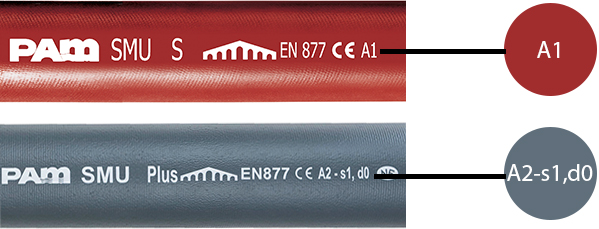
In tests carried out by Warrington Fire and the CSTB accredited laboratory, our cast iron ranges (pipes, fittings and accessories, including elastomer gaskets and coatings) received the following excellent Euroclass ranking: A1 for our Ensign above-ground range and A2-s1, d0 for the Ensign below ground range.
Cast iron remains one of the best materials when it comes to fire safety !
ACCREDITED
Pam Building cast iron systems are among the safest materials on the market in terms of reaction to fire, and all its drainage systems have been tested independently of the stipulated test criteria.
In tests carried out by Warrington Fire and the CSTB accredited laboratory, our cast iron ranges (pipes, fittings and accessories, including elastomer gaskets and coatings) received the following excellent Euroclass ranking: A1 for our Ensign above-ground range and A2-s1, d0 for the Ensign below ground range.
Cast iron remains one of the best materials when it comes to fire safety !
STANDARDS
The UKCA and CE marking for cast iron wastewater systems is based on the harmonised standard EN 877, which applies to a system including pipes, fittings, couplings and accessories, and is used to test all of the ranges’ components.
When specifying your products you need to check the reaction to fire classification to ensure the tests were carried out by an accredited testing centre. Our compliance is validated by the quality marks, is periodically tested by accredited third-party laboratories and provides you with a performance guarantee for the systems you specify.
COMPARTMENTAL PRINCIPLE
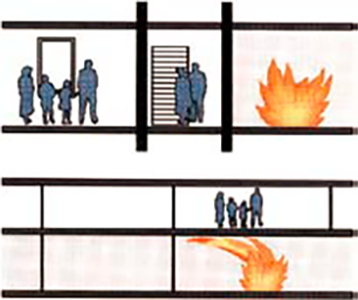
When they exist, fire safety regulations for buildings are based on a compartmental principle. Within a building, a compartment is a fire-rated space designed to stop the fire for a given period of time. The fire stopping requirement for walls (shells and slabs) is generally 2 hours or less - and exceptionally 4 hours.
The requirement depends on the type of building and its level of occupancy.
COMPARTMENTAL PRINCIPLE
When they exist, fire safety regulations for buildings are based on a compartmental principle. Within a building, a compartment is a fire-rated space designed to stop the fire for a given period of time. The fire stopping requirement for walls (shells and slabs) is generally 2 hours or less - and exceptionally 4 hours.
The requirement depends on the type of building and its level of occupancy.
Waste water drainage systems and fire stopping requirement
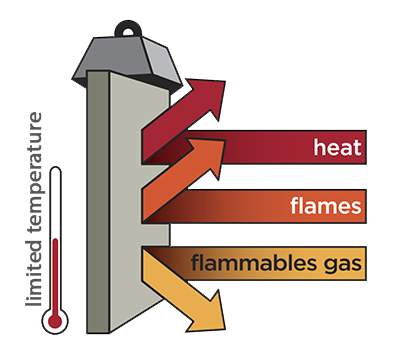
Drainage systems passing through structures designed to withstand fire should not provide open breaches. For a given time, specified in the applicable regulations, they should not allow the passage of fire, smoke, heat or combustion products from one compartment another.
Cast iron, a non-combustible material, has a melting point of over 1000°C. In most cases it requires no additional fire protection.
Pam Building has and will continue to periodically test its cast iron drainage systems with standard mortar penetrations and other solutions in order to understand the potential effects of fire on its integrity, resistance and overall performance. We carried out a non-exhaustive series of tests to offer precise guidance for fire resistance.
Our systems proved to meet integrity and insulation requirements up to 240 minutes (4 hours)*, and should therefore not collapse causing potential danger to evacuating people or firefighters.
We regularly perform new tests. Therefore, if you have any questions our technical team can provide guidance and help you select the right configuration for optimal performance and provide you with a comprehensive report. You can contact our technical support team on our website
Waste water drainage systems and fire stopping requirement
Drainage systems passing through structures designed to withstand fire should not provide open breaches. For a given time, specified in the applicable regulations, they should not allow the passage of fire, smoke, heat or combustion products from one compartment another.
Cast iron, a non-combustible material, has a melting point of over 1000°C. In most cases it requires no additional fire protection.
Pam Building has and will continue to periodically test its cast iron drainage systems with standard mortar penetrations and other solutions in order to understand the potential effects of fire on its integrity, resistance and overall performance. We carried out a non-exhaustive series of tests to offer precise guidance for fire resistance.
Our systems proved to meet integrity and insulation requirements up to 240 minutes (4 hours)*, and should therefore not collapse causing potential danger to evacuating people or firefighters.
We regularly perform new tests. Therefore, if you have any questions our technical team can provide guidance and help you select the right configuration for optimal performance and provide you with a comprehensive report. You can contact our technical support team on our website
COMPARISON WITH OTHER MATERIALS
For plastics, the fire stopping rule consists in “plugging the hole”. This function is achieved by using fire collars recommended by the manufacturers. Plastic materials, which are highly sensitive to heat, will not withstand fire, and will not remain in place, even in the case of a contained fire. As shown by laboratory tests in Germany, if the fire collars are not activated, particularly when installed under the fire compartment, they significantly increase the risk of the fire spreading downwards in a multi-storey building. When some types of plastic material (e.g. HDPE and Polypropylene) are exposed to fire they generate molten droplets, which could potentially spread a fire down through the building.
Exposed to fire, plastic material releases toxic fumes and gases, which beyond a certain amount may be fatal to the people inhaling them.
Choosing Pam Building Cast Iron Systems means guaranteeing the safety of people and property.